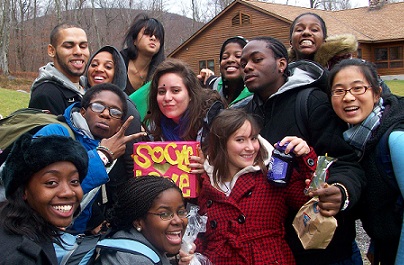
Students of Color (SOC) @ Columbia provides students with cultural student group advising, events, education, advocacy and other resources to help all students explore and better understand racial and ethnic identities, histories, experiences and communities at Columbia and beyond. Additionally, as part of Multicultural Affairs, we hope to create a campus environment that is inclusive and supportive of student diversity in the areas of race and ethnicity.
For more information, please email Multicultural Affairs at multicultural@columbia.edu. Be sure to subscribe to our Students of Color @ Columbia announcements for updates and events!
Programs and Events
- The Stoop: Annual kick-off event for SOC @ Columbia on Low Steps
- SOC @ Columbia Outings
- SOC @ Columbia Study Breaks
- SOC @ Columbia Mental Health and Wellness Series
- SOC @ Columbia Programming Board: undergraduates who work with Multicultural Affairs staff to develop and implement programming that focuses on shared and divergent experiences among SOC, explores inter-POC dynamics and conflict, and builds solidarity among communities
- Columbia Mentoring Initiative (CMI): mentor and mentee opportunities within and among communities including Arab & Middle Eastern, Asian, Black, Indigenous, Latinx, and Mixed Heritage Family Trees
- Anti-Racism Teach-in
- Multicultural Graduation Celebrations
- Sankofa Tzedek: brings together a cohort of students on campus for a year of personal identity development, intergroup dialogue, intercultural learning, relationship-building, and social justice education that centers the experiences and histories of Black and Jewish communities
- Students Exploring Whiteness: yearlong cohort of students who desire a space for sustained personal work and peer support around understanding race and challenging racism with a goal of developing an anti-racist framework and toolkit that can be brought to other student communities on campus. We hope to create a space of nourishment and accountability that will produce meaningful partnerships and achievable action steps
Advocacy
The Student of Color Advisory Board (SOCAB) is part of the Multicultural Affairs Advisory Council (MAAC) under Multicultural Affairs. These undergraduate students work towards a more respectful, accountable and socially just campus environment by identifying campus issues and work closely and collaboratively with Multicultural Affairs and other campus partners to develop realistic and action-oriented solutions.
Like each MAAC student advisory board, SOCAB works with a corresponding administrative resource team spearheaded by Multicultural Affairs. Informed by the work of SOCAB, the SOC Resource Team is a cross-functional team responsible for identifying unique and/or specific issues facing students of color. Each individual member of the team serves as a liaison, contributes to the conversation and shares pertinent information back to their respective office. Each team supports the development, planning and implementation of initiatives aimed at assisting their respective population of students in Columbia College and Columbia Engineering. SOC team membership consists of staff from Multicultural Affairs, Center for Student Advising, Counseling and Psychological Services, Undergraduate Admissions, Global Programs and Fellowships, Center for Career Education, Alumni Affairs, Alice! Health Promotion and Sexual Violence Response.
Organizational Advisement
- Multicultural Affairs advises over 40 cultural and identity-based student organizations
- Additionally, students can get in involved in interest-based cultural groups, such as:
- Multicultural pre-professional organizations
- Cultural performance organizations
- Multicultural fraternities and sororities
Campus Resources
Campus-Wide Resources
- Multicultural Team in Counseling and Psychological Services
- Center for Career Education, including the CCE Clothing Closet
- Global Programs and Fellowships: Identity and Diversity Abroad
- Community Spaces
- Malcolm X Lounge (overseen by the Black Students' Organization)
- Alumni Groups
- Asian Columbia Alumni Association (ACAA)
- Black Alumni Council (BAC)
- Latino Alumni Association of Columbia University (LAACU)
Columbia College and Columbia Engineering Resources
- SOC @ Columbia
- Student of Color Advisory Board, part of the Multicultural Affairs Advisory Council
- Special Interest Communities
- Intercultural House
- Casa Latin@
- Manhattan House
- Pan-African House
- Columbia College Odyssey Mentoring Program
- Columbia College and Columbia Engineering Undergraduate Deans’ Student Assistance Fund (DSAF)